LENGO
 App
 Languages
 Stories
 Become a creator
 Featuring program
 Affiliate program
 Beta program
 one sec × LENGO
 Contact & help
 About LENGO
 Team & jobs
 Press kit
 Privacy
 Terms
How Children and Adults Learn, and What the Wug Test Reveals About Grammar
 Amelia
October 25, 2026 · 6 min read
Children learn to walk, talk and ride a bike without ever opening a manual. Adults usually want the manual first. Neither way is wrong: children and adults simply learn differently. And when it comes to learning a new language, that difference matters more than most people think.
How children learn
Children learn by doing. They try, fall, laugh and try again. Nobody explains balance to a four-year-old on a bike; the child simply rides until it works. Most of this learning happens without the child even noticing. Researchers call it implicit learning: the brain picks up patterns from experience without anyone pointing them out.
Babies are astonishingly good at it. In a well-known experiment, eight-month-old infants listened to a stream of made-up syllables for just two minutes. Afterwards they could already tell which syllables belonged together as "words", purely from how often the syllables followed each other (Saffran, Aslin and Newport, 1996).
Children also have two things on their side: time and a lack of fear. A child spends years surrounded by people who show, repeat and correct, and has little else to do. And a child doesn't mind getting things wrong.
How adults learn
Adults learn differently. They rarely just soak things up. They want to understand. They connect new knowledge to what they already know, follow an explanation, keep several steps in mind at once and think about how they learn best. Nobody learns to drive by sitting in a car for years and watching. You take lessons, learn the rules of the road and what each pedal does, and then practice until it all happens on its own.
In return, adults have less time, more distractions and often more fear of making mistakes. Their strength is understanding, and they learn fastest when they get to use it.
What this means for languages
Nowhere is the difference as clear as with language. Every child learns its first language without a single grammar lesson. It hears its language for thousands of hours before saying a full sentence: at breakfast, in the bath, at bedtime, day after day. That is why many adults believe they should learn a new language "like a child", just by listening and copying.
But to learn like a child, you would also need a child's years of listening. To see what adults can do instead, it helps to look at what children actually take away from all those hours. A small blue bird from 1958 shows it.
A bird called wug
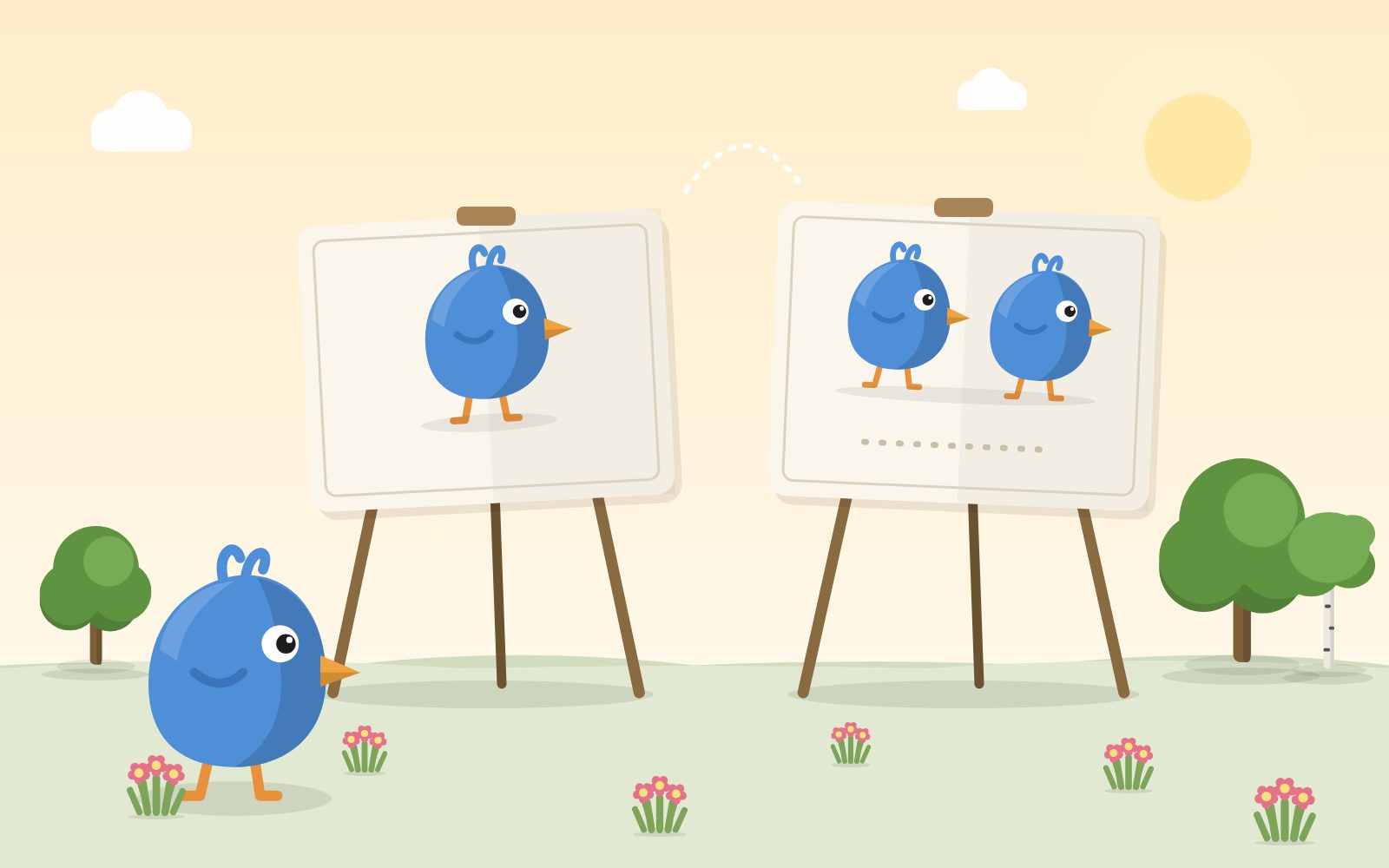
In 1958 the American psycholinguist Jean Berko, today known as Jean Berko Gleason, published a study that became one of the best known in linguistics. She showed children between four and seven years old simple drawings of creatures and activities that did not exist. One card showed a small, bird-like figure: "This is a wug." The next card showed two of them: "Now there is another one. There are two of them. There are two ___."
The children said "wugs". On another card, a man "knows how to rick". He did the same thing yesterday. What did he do yesterday? "He ricked."
That sounds trivial, but it isn't. None of the children could have heard these words before, because Berko had made them up. There was nothing to repeat. To say "wugs", a child had to know a rule (add -s for more than one) and apply it to a word heard for the very first time. Children don't just collect words. They collect rules. You can even hear it: at some point children say "goed" instead of "went" and "mouses" instead of "mice". They have found a rule and now use it everywhere, even where it doesn't belong.
Try it yourself
Here are two more words from Berko's test. Put each one into the form the sentence needs. The test works best if English is your native language, because then it shows what you know without ever having studied it.
Your wug test
Two words that nobody has ever used. Put each one into the form the sentence needs.
This is a tass. Now there is another one. There are two of them.
This is a man who knows how to bod. He is bodding. He did the same thing yesterday.
You know the rules, even if you never learned them
Did you get both? Native speakers almost always do, often without a second's thought. Berko's children found exactly these two words hard: many of them said "two tass", and most could not turn "bod" into "bodded". The extra syllable in "tasses" and "bodded" is one of the last pieces of the system to fall into place.
And yet you probably couldn't have explained the rule before you took the test. You can't have memorized the form of a word that doesn't exist. You produced it, and to do that you had to apply a rule. Many people say they are "bad at grammar". The wug test shows the opposite: knowing a language means knowing its rules, whether you can name them or not.
Why adults should learn the rules
As a child, you built the rules of your native language out of years of listening. As an adult learning a new language, you don't have those years. But you have something children don't: you can be told a rule and use it right away. Research shows how big that advantage is.
- When English-speaking families moved to the Netherlands, the teenagers and adults made faster progress in Dutch in the first months than the young children. The youngest learners, aged three to five, scored lowest (Snow and Hoefnagel-Höhle, 1978).
- A review of 49 studies on language teaching found that learners who had the rule explained to them made clearly greater progress than learners who only saw examples (Norris and Ortega, 2000). A later review of 41 studies found the same for simple and complex grammar alike (Spada and Tomita, 2010).
- Among Hungarian immigrants in the United States who had arrived as adults, the few whose grammar was as good as that of people who came as children had one thing in common: a strong talent for analyzing language (DeKeyser, 2000). Adults who reach the top get there by understanding, not by soaking it up like a child.
Why the rule should come first
An adult who learns only from examples has to guess the rule behind them. Sometimes the guess is right. Often it is only half right. A learner of Spanish hears libros, casas and mesas and concludes that Spanish plurals simply add -s. Then come papeles and ciudades, and the guess falls apart.
And every guess gets practiced. The brain strengthens what we repeat: each time you use a form, the connection behind it grows a little stronger, whether the form is right or wrong. Practice a wrong guess for months and you build a wrong path that you later have to unlearn, and unlearning is harder than learning. Start with the rule and every sentence you build strengthens the right pattern from the very first day. The examples then do what they do best: they turn the rule into a habit until it comes as easily as your answers in the test above.
So rules don't replace examples. They give examples a direction. Children need years to discover the rules in what they hear. Adults can simply be told, and save those years.
How LENGO puts this into practice
That is why every grammar lesson in LENGO starts with the rule: a short explanation, then examples, then exercises in which you apply the rule yourself, just like in the wug test. The words you learn come back at growing intervals, just before you would forget them, so rules and vocabulary grow together. You can browse the grammar lessons for all 29 languages right here on the website.
So the next time you think you are bad at grammar, remember the wug. You already know more rules than you think. Learn the next one, practice it, and soon it will come just as naturally.
Sources
- Berko, J. (1958). The child's learning of English morphology. Word, 14, 150-177.
- Saffran, J. R., Aslin, R. N., and Newport, E. L. (1996). Statistical learning by 8-month-old infants. Science, 274(5294), 1926-1928.
- Snow, C. E., and Hoefnagel-Höhle, M. (1978). The critical period for language acquisition: Evidence from second language learning. Child Development, 49(4), 1114-1128.
- Norris, J. M., and Ortega, L. (2000). Effectiveness of L2 instruction: A research synthesis and quantitative meta-analysis. Language Learning, 50(3), 417-528.
- Spada, N., and Tomita, Y. (2010). Interactions between type of instruction and type of language feature: A meta-analysis. Language Learning, 60(2), 263-308.
- DeKeyser, R. M. (2000). The robustness of critical period effects in second language acquisition. Studies in Second Language Acquisition, 22(4), 499-533.