LENGO
 App
 Languages
 Stories
 Become a creator
 Featuring program
 Affiliate program
 Beta program
 one sec × LENGO
 Contact & help
 About LENGO
 Team & jobs
 Press kit
 Privacy
 Terms
Ordinal or Cardinal?
1. Greek Numbers 0-9
0 μηδέν (midén)
1 ένα (éna)
2 δύο (dío)
3 τρία (tría)
4 τέσσερα (tésera)
5 πέντε (pénde)
6 έξι (éxi)
7 επτά (eptá)
8 οκτώ (októ)
9 εννέα (enéa)
2. Greek Numbers 10-99
10 δέκα (déka)
11 έντεκα (éndeka)
12 δώδεκα (dódeka)
13 δεκατρία (dekatría)
14 δεκατέσσερα (dekatésera)
15 δεκαπέντε (dekapénde)
16 δεκαέξι (dekaéxi)
17 δεκαεπτά (dekaeptá)
18 δεκαοκτώ (dekaoktó)
19 δεκαεννέα (dekaenéa)
All of the above numbers consist of one word, of which the prefix indicates the first digit and the suffix represents the second digit.
Numbers 11 or έντεκα (éndeka) and 12 or δώδεκα (dódeka) are the only two-digit numbers that don’t follow the afore mentioned rule.
20 είκοσι (íkosi)
21 είκοσι ένα (íkosi éna)
22 είκοσι δύο (íkosi dío)
23 είκοσι τρία (íkosi tría)
Every number greater than 20 consists of two words. The first word refers to the first digit and the second word indicates the second digit respectively. Another attention point is that 21 or είκοσι ένα (íkosi éna) and 22 or είκοσι δύο (íkosi dío) just follow the rule.
Greater numbers consist of two words. The first one will be one of the following, accompanied by a second word which will indicate the second digit 1-9.
20 είκοσι (íkosi)
30 τριάντα (triánda)
40 σαράντα (saránda)
50 πενήντα (penínda)
60 εξήντα (eksínda)
70 εβδομήντα (evdomínda)
80 ογδόντα (ogdónda)
90 ενενήντα (enenínda)
The second digit, which is 0 or μηδέν (midén,) isn’t pronounced in Greek, as each of these words has a unique one-word name.
3.Cardinal Numbers
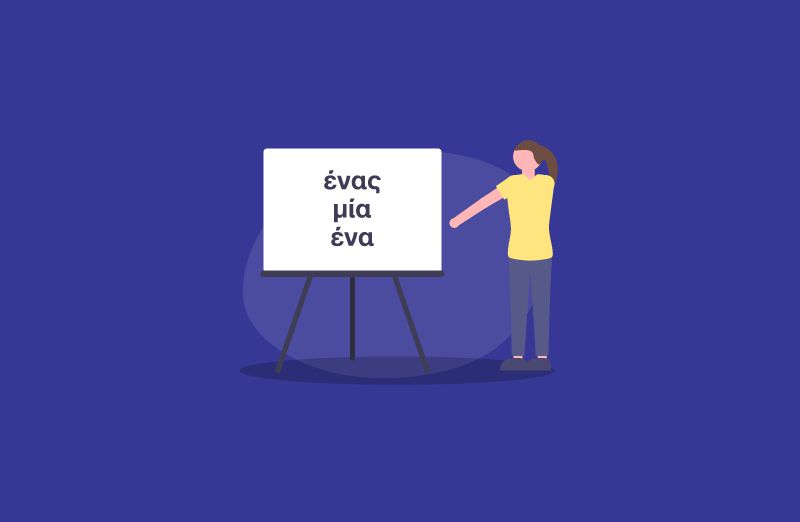
Cardinal numbers, ένας, μία, ένα are considered adjectives in Greek, so they need to agree in gender, number, and case with the noun they define.
Masculine: ένας κηπουρός
Feminine: μία κοπέλα
Neuter: ένα παιδί
4. Ordinal Numbers
Ordinal numbers are also adjectives and they are declinable like nouns. Each ordinal number has three variations, showcasing the different endings -ος -η, -ο, depending on whether the referenced noun is masculine, feminine, or neutral.
1st πρώτος / -η / -ο (prótos / -i / -o)
2nd δεύτερος (défteros)
3rd τρίτος (trítos)
4th τέταρτος (tétartos)
5th πέμπτος (pémptos)
6th έκτος (éktos)
7th έβδομος (évdomos)
8th όγδοος (ógdoos)
9th ένατος (énatos)
10th δέκατος (dékatos)
11th ενδέκατος (endékatos)
12th δωδέκατος (dodékatos)
13th δέκατος τρίτος (dékatos trítos)
14th δέκατος τέταρτος (dékatos tétartos)
……..
20th εικοστός (ekatostós)
21st εικοστός πρώτος (ekatostós prótos)
22nd εικοστός δεύτερος (ekatostós défteros)
……
30th τριακοστός (triakostós)
40th τεσσαρακοστός (tesarakostós)
50th πεντηκοστός (pendikostós)
60th εξηκοστός (exikostós)
70th εβδομηκοστός (evdomikostós)
80th ογδοηκοστός (ogdoikostós)
90th ενενηκοστός (enenikostós)
100th εκατοστός (ekatostós)